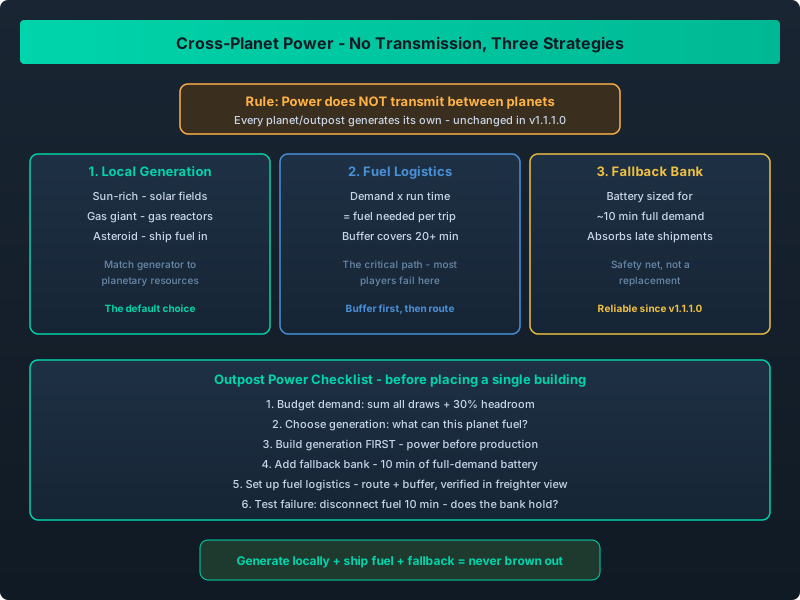
No cross-planet power: generate locally, ship fuel, keep a fallback
The Power Rule That Shapes Your Empire
Here is a rule you will hit the moment you colonize a second planet: power does not transmit between planets. No cables, no wireless, no wormhole power taps. Every planet (and every distant outpost) must generate its own power.
This is one of the most common complaints in Outworld Station reviews – and v1.1.1.0 did not change it. But it is not a design flaw; it is a logistics puzzle. This guide is the v1.1.1.0-verified playbook for powering outposts without transmission.
Every planet generates its own power. Match the generator to the planet’s local resources: solar where there is sun, reactors where there is fuel, and always ship a fuel buffer. The winning pattern is local generation + shipped fuel + a small battery/fallback bank. Never build a power-hungry outpost without first budgeting its local fuel supply chain.
The Three Strategies
1. Local Generation (The Default)
Match generators to what the planet has:
| Planet type | Best generation |
|---|---|
| Sun-rich | Solar fields (Power Source Comparison) |
| Gas giant | Gas-based reactors (see Deep Space Gas Giant Mining) |
| Asteroid/rock | Ship fuel in; run compact reactors |
The rule: generate from local abundance, import only what the planet lacks.
2. Fuel Logistics (The Critical Path)
If a planet cannot generate enough locally, you ship fuel. This is where most players fail – they ship the resource but forget the supply chain math:
Outpost demand (MW) × run time = fuel needed
Fuel per freighter trip = capacity
→ Trips per hour = demand / capacity
A freighter route that delivers fuel every 20 minutes works only if the outpost’s buffer covers 20+ minutes of demand. Build the buffer first, then tune the route. See Freighter & Mining Guide for route tuning and the Freighter Overview to monitor it.
3. Fallback Bank (The Safety Net)
Every outpost gets a small battery/fallback bank sized for ~10 minutes of full demand. It does not replace generation – it absorbs the gap when a fuel shipment is late or a solar field dips. The v1.1.1.0 power fixes (no phantom reactor animations, stable load behavior) make fallback banks more reliable than they were at launch.
Use the v1.1.1.0 factory sound sliders to hear when an outpost’s generators are struggling. Set machine audio loud, music low, and your ears become a power-status monitor while you work on the main station.
The Outpost Power Checklist
Before placing a single building on a new planet:
- Budget demand: sum every machine’s power draw, add 30% headroom.
- Choose generation: what does this planet produce that can fuel it?
- Build generation first: power before production, always.
- Add the fallback bank: 10 minutes of full-demand battery.
- Set up fuel logistics: route + buffer, verified in the freighter view.
- Test the failure case: disconnect the fuel route for 10 minutes. Does the fallback hold?
Fuel imports can hit the 540 items/min logistics cap on busy routes. If your outpost needs more fuel than one channel can carry, you need parallel channels – not a bigger belt. The cap applies to fuel just like everything else.
The Mid-Game Sweet Spot
For most mid-game empires, the practical pattern is:
- Home station: reactor block + solar supplement (see Fusion Reactor Guide).
- First mining planet: solar + shipped fuel buffer.
- Gas giant rig: burns local gas, exports fuel to the other outposts.
This covers 90% of expansions without ever needing “transmission” – which the game does not offer and does not plan to (no announcement as of v1.1.1.0).
Cross-planet power transmission does not exist in Outworld Station, and it is not coming in v1.1.1.0. Stop waiting for it: generate locally from planetary resources, ship fuel with a real buffer, and keep a fallback bank on every outpost. The checklist above turns power management from a crisis into a routine – and your multi-planet empire (Multi-Planet Expansion Guide) will never brown out again.