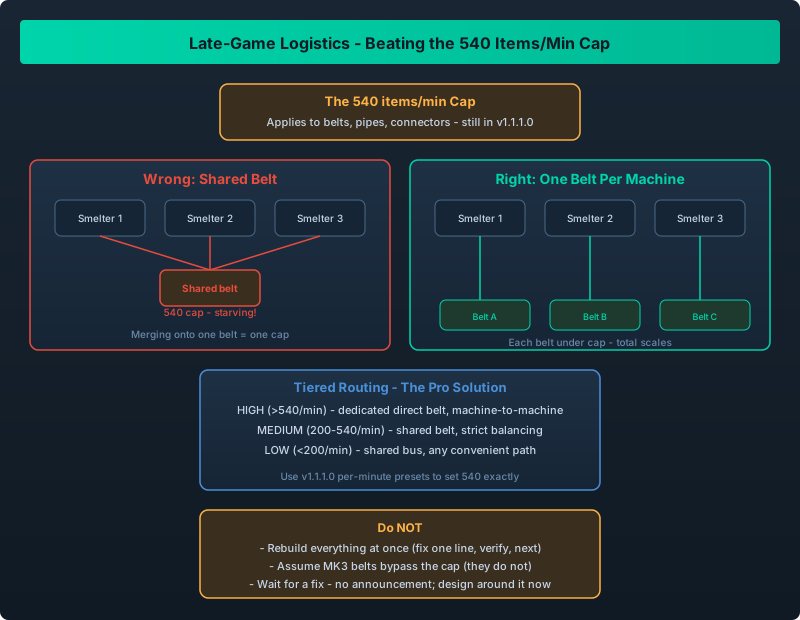
The 540 cap: one belt per machine class, split lanes, and tiered routing that survives late game
The Wall Every Late-Game Player Hits
If you have reached station level 11+ and watched your factory grind to a halt, you have met the 540 items/min logistics cap. It is the single most-cited complaint in Outworld Station reviews – and yes, v1.1.1.0 did not fix it.
The good news: the cap is survivable. You just cannot build the way you did in the early game. This guide is the practical redesign playbook.
The 540 cap means one logistics channel (belt/pipe/connector) tops out at 540 items/min. You beat it by parallelism, not speed: split one 540-demand machine group across multiple dedicated channels, give every high-throughput machine its own belt, and use tiered routing so low-volume items never compete with high-volume ones. The cap is a design constraint, not a bug – and it is deliberately still present in v1.1.1.0.
Understanding the Cap
| Fact | Detail |
|---|---|
| Hard limit | ~540 items/min per logistics channel |
| What it applies to | Belts, pipes, connector throughput |
| When it bites | Station level 11+, dense factory cores |
| Fixed in v1.1.1.0? | No |
The cap bites hardest when one machine or one line wants more than 540/min. The game does not queue overflow – it just starves the consumer.
The Three Workarounds
1. One Belt Per Machine Class (The Simple Fix)
The moment a machine class wants more than 540/min, stop merging its output onto a shared belt.
Wrong:
Smelter 1 ─┐
Smelter 2 ─┼─► shared belt (540 cap) ─► starving
Smelter 3 ─┘
Right:
Smelter 1 ─► belt A ─► consumer
Smelter 2 ─► belt B ─► consumer
Smelter 3 ─► belt C ─► consumer
Each belt stays under the cap and the total throughput scales. This is the “one belt per machine” rule from the Conveyor Balancing Guide, applied ruthlessly.
2. Dedicated Pipes for Fluids & Gas
Gas and fluid lines hit the same cap. The Pipe Bottleneck Guide and Liquid Gas Pipe Network Design cover the mechanics; the late-game rule is simpler:
- One gas type per pipe. Never mix Nitrox and Hydrogen on the same trunk.
- Parallel pipes for high-demand consumers. A smelter block wanting 800/min of gas gets two pipes, not one.
- Buffer at the machine, not the trunk. Small buffers at each consumer smooth bursts without overloading the trunk.
3. Tiered Routing (The Pro Solution)
Categorize every item by volume and route accordingly:
| Tier | Volume | Routing |
|---|---|---|
| High | >540/min demand | Dedicated direct belt, machine-to-machine |
| Medium | 200-540/min | Shared belt with strict balancing |
| Low | <200/min | Shared bus, any convenient path |
Build a tier map of your factory: which items are high-volume, which are medium, which are low. Then route each tier differently. High-volume items never touch the shared bus. This is the late-game evolution of the Assembly Line Ratios approach.
The v1.1.1.0 per-minute rate presets (new in this patch) make tiered routing easier: set each machine’s efficiency by items/min instead of percentage. When a machine needs exactly 540/min on its dedicated belt, set it to 540 and stop guessing.
The Complete Late-Game Pattern
For a station core at level 11+:
- Map your top 5 high-volume items (usually plates, circuits, gas, alloy, and one exotic).
- Give each a dedicated direct channel from producer to consumer.
- Route everything else on a tiered shared bus with strict filters (see Item Exclusion Filters).
- Use the freighter overview (guide) to verify nothing is starving.
- Let buffers absorb spikes (Buffer Storage Strategy) instead of expecting belts to.
What NOT To Do
- Do not rebuild the whole factory at once. Fix one high-volume line, verify, move on.
- Do not assume MK3 belts bypass the cap. They do not – the 540 cap applies regardless of belt tier (see MK2/MK3 Factory Guide).
- Do not wait for a fix. The developer has not announced one for the cap; design around it now.
The 540 cap is the defining constraint of late-game Outworld Station, and it is still here in v1.1.1.0. But it is beatable: parallel dedicated channels for high-volume items, tiered routing for everything else, and the new per-minute presets to tune it all. Redesign one line at a time and your level 13+ factory will run at full speed – no fix required.